Find the cause of every incident, faster.
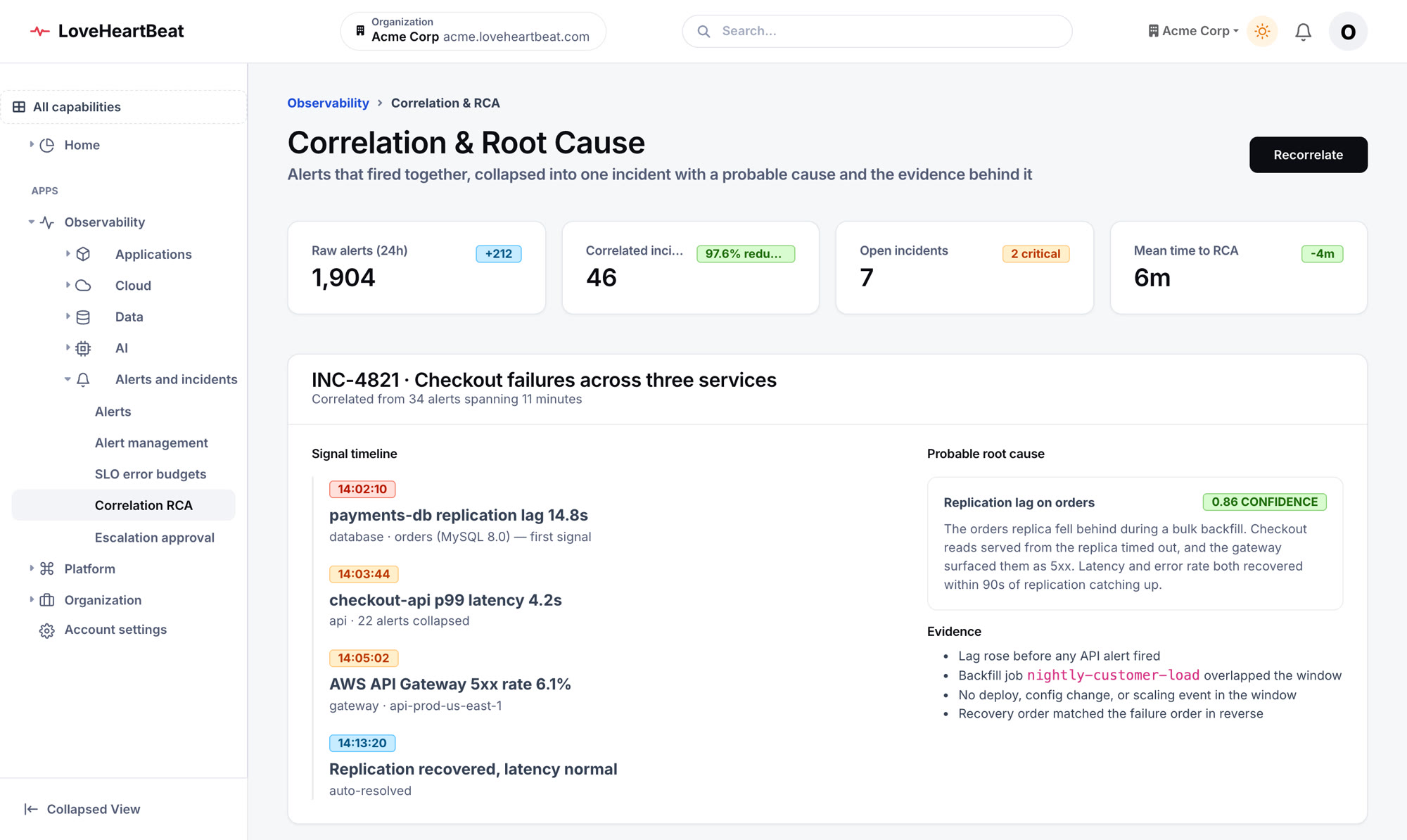
LoveHeartBeat brings application, data, cloud and AI telemetry into one platform. It correlates related alerts into a single incident and identifies the probable cause, with the evidence behind it.
Free for up to 5 users. No credit card required.
Integrates with the tools your teams already use
- OpenTelemetry
- AWS
- Azure
- Google Cloud
- PagerDuty
- ServiceNow
- Databricks
- Airflow
- Control-M
- PostgreSQL
- Kafka
- GitHub
One platform for every layer of your stack
Applications, data, cloud and AI share one data model, so an alert in one area carries context from the others.
Applications & APIs
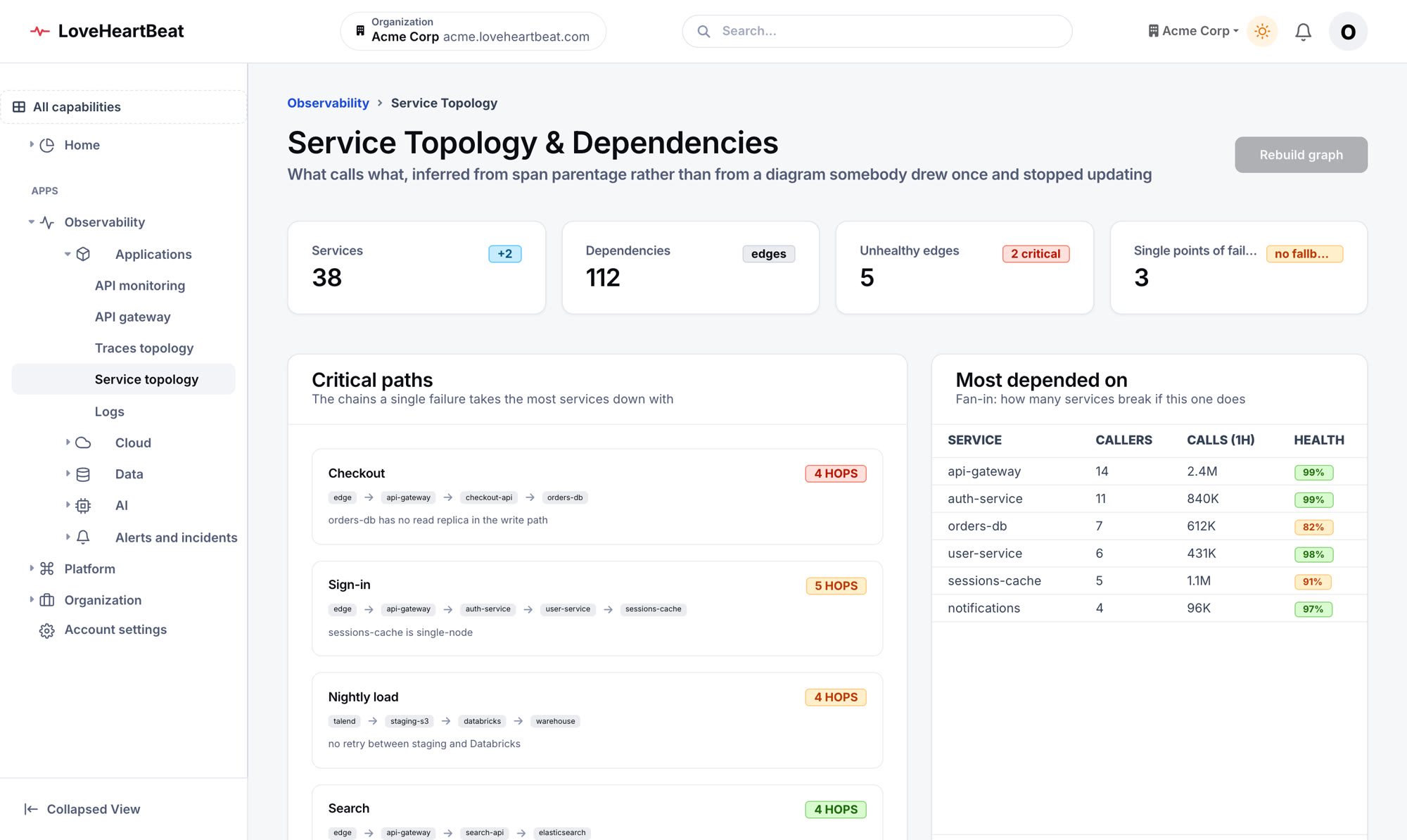
Traces, metrics and logs over OpenTelemetry, with a service map built from real traffic.
- Distributed tracing
- API and gateway monitoring
- Log search and error patterns
Data & pipelines
Health of the databases, ETL jobs and orchestrators that move your data.
- Schema drift between environments
- Volume anomalies per table
- Airflow, Control-M, Glue, Databricks
Cloud
AWS, Azure and Google Cloud accounts in one view, with change history and spend.
- Multi-cloud health
- AWS change tracking
- Cost and usage trends
AI & LLM applications
Visibility into agents and model calls: latency, failures, tokens and cost.
- Agent and model traces
- Token usage and cost by model
- AI gateway analytics
Alerts & SLOs
Alerting that pages on what matters, measured against the objectives you set.
- Alert grouping and noise reduction
- SLOs and error budgets
- Escalation policies
Incident analysis
Related alerts correlated into one incident, with the probable cause and its evidence.
- Cross-source correlation
- Ranked root-cause candidates
- Runbooks with human approval
From alert to resolution
When something breaks, every signal from those layers follows the same deterministic path. Automated analysis adds evidence along the way, and people stay in control of every change.
- 01
Ingest
Telemetry and events from PagerDuty, ServiceNow and your services arrive through a scoped ingest key. Redeliveries attach to the existing incident.
- 02
Correlate
Alerts are grouped by pattern, service and time window, and the affected services are identified from the dependency map.
- 03
Identify the cause
Likely causes are ranked from recent changes, similar past incidents and failing dependencies. Each one cites its evidence.
- 04
Remediate
Suggested runbooks and fixes pass policy checks and wait for approval. Every action is dry-run first and can be rolled back.
Understand dependencies before they fail
Correlation depends on knowing what calls what. The dependency map is built from your traces rather than drawn by hand, so it stays current as your services change.
- Critical paths and the services each one depends on
- Single points of failure, flagged automatically
- Blast radius for every incident
Automation you can trust
Faster answers only help if you can rely on them. These guarantees hold on every plan.
Evidence first
Every automated finding links to the change, incident or trace it is based on.
Human approval
No change reaches production without passing policy checks and an explicit approval.
Open standards
OpenTelemetry and standard webhooks in. No proprietary agent required.
Tenant isolation
Each organization has its own data scope, ingest keys and access controls.
Ready for your whole organization
Identity, access and billing controls are included on every plan.
SAML single sign-on
Connect Okta, Entra ID or any SAML 2.0 identity provider.
Verified domains
Prove domain ownership with DNS and let colleagues join automatically.
Multiple organizations
Belong to several organizations and switch between them with one login.
Roles and invitations
Invite by email, assign roles, and revoke access at any time.
Scoped ingest keys
Per-organization keys that can only send data, never read it.
Seat-based billing
Plans priced by seat, managed from the billing page.
Frequently asked questions
Something else? Contact us
How long does setup take?
Most teams send their first event within minutes: create an organization, generate an ingest key, and point an OpenTelemetry exporter or a PagerDuty or ServiceNow webhook at it. The onboarding checklist confirms when the first event arrives.
Do I need to install an agent?
No. LoveHeartBeat accepts standard OTLP traces, metrics and logs, and webhooks from the alerting and ITSM tools you already use.
Can the platform make changes to production?
Not on its own. Analysis is read-only. Any runbook or fix must pass policy checks and be approved by a person, and every action is dry-run first and can be rolled back.
Get started in minutes
Create an organization, send your first event, and see your first correlated incident, all on the free plan.